
How Cash Quietly Drains Profit from Kenyan Businesses

2%+

A small daily loss feels harmless until it compounds into hundreds of thousands over a year.

KSh 66K+

That is the kind of monthly cash drag many businesses absorb without ever tracking it properly.

More Control

Digital payments give you records, visibility, and a clearer view of what is really happening in the business.

Also available as a podcast
How Cash Quietly Drains Profit from Kenyan Businesses
Cosmo Pawa · Spotify
▶ Listen on Spotify

The “free” option that is not free

A business handling KSh 100,000 a day and losing just 2% is losing KSh 2,000 every day. That is more than KSh 700,000 a year.

The real monthly cost of cash

Hidden CostMonthly Estimate
Staff shrinkage and theftKSh 24,000 to 60,000
Counting and reconciliation errorsKSh 10,000 to 20,000
Banking time and transportKSh 9,000 to 15,000
Lost sales from no-change momentsKSh 15,000 to 40,000
Security risk exposureKSh 5,000 to 20,000

Estimated total: KSh 66,000 to 163,000 per month.

That money usually does not appear as a clear “cash expense” in your books. It simply shows up as lower margins, slower growth, and profits that never feel as strong as they should.

Why most business owners miss it

Cash losses are quiet

They rarely arrive as one dramatic event. They come through under-counting, small mistakes, missing change, under-reporting, and moments no one tracks properly.

Digital fees are visible

Because the charge is easy to see, it feels more painful. But visible cost is not always the bigger cost. In many cases, cash is far more expensive.

Reality check: A 0.5% fee on KSh 3 million in turnover is about KSh 15,000. Cash losses on the same turnover can be several times higher.

The bigger problem: no data

Cash businesses often operate blind. You may know the total at the end of the day, but you do not have the detail needed to make sharper decisions.

  • No visibility into sales patterns
  • No clear staff performance data
  • No reliable history for planning
  • No strong records for lenders or compliance

With digital payments such as Lipa Na M-Pesa and a modern POS setup, every sale is logged automatically. That means better reconciliation, cleaner records, easier reporting, and fewer surprises at day-end.

Cash vs digital

Cash

Familiar, but costly

  • Hidden losses build up quietly
  • Manual counting takes time
  • Staff theft is hard to detect
  • Lost sales when change is unavailable
  • More physical security risk

Digital

Small fees, stronger control

  • Every transaction is recorded
  • Reconciliation becomes faster
  • Less cash on site means less risk
  • Better reporting and visibility
  • Stronger data for growth and compliance

Start simple

You do not need to change everything overnight. Start by adding digital payment options alongside cash, then move into a full system as the business gets more comfortable.

  • Add an M-Pesa till number
  • Accept QR payments
  • Track sales digitally
  • Upgrade to a modern POS when ready

Cash is not free. It is quietly expensive.

The sooner you reduce cash risk and improve visibility, the sooner you take back control of your margins.

Quarter-End Secrets Every Smart Retailer Needs Right Now

Q1 is wrapping up. For many Kenyan business owners — whether you run a minimart, a wine & spirits shop, a bar, or a general merchandise store — the end of March brings a familiar mix of relief and dread. Relief that the quarter is done. Dread because now you have to make sense of everything that happened over the past three months.

Receipts to reconcile. Stock to verify. Expenses to account for. Reports to pull together. In fact, for businesses still running on manual systems or basic spreadsheets, this process can eat up days of your time. As the Kenya Revenue Authority requires businesses to maintain accurate financial records, getting your books in order at quarter-end is not just good practice — it is a legal obligation.

However, if you have a POS system, the good news is: the work is largely already done. The data is there. The reports are waiting. Furthermore, unlike manual methods, a modern POS gives you instant access to everything you need in one place. You just need to know what to look for — and in what order. As a result, what used to take days can now take a few focused hours. According to Safaricom’s SME business resources, integrated digital tools are one of the biggest drivers of efficiency for small and medium businesses in Kenya — and your POS is exactly that.

Also available as a podcast

Quarter-End Secrets: The 8-Step POS Checklist Every Kenyan Retailer Needs

Cosmo Pawa · Listen on Spotify

Also available as a podcast
Quarter-End Secrets: The 8-Step POS Checklist Every Kenyan Retailer Needs
Cosmo Pawa · Spotify
▶ Listen on Spotify

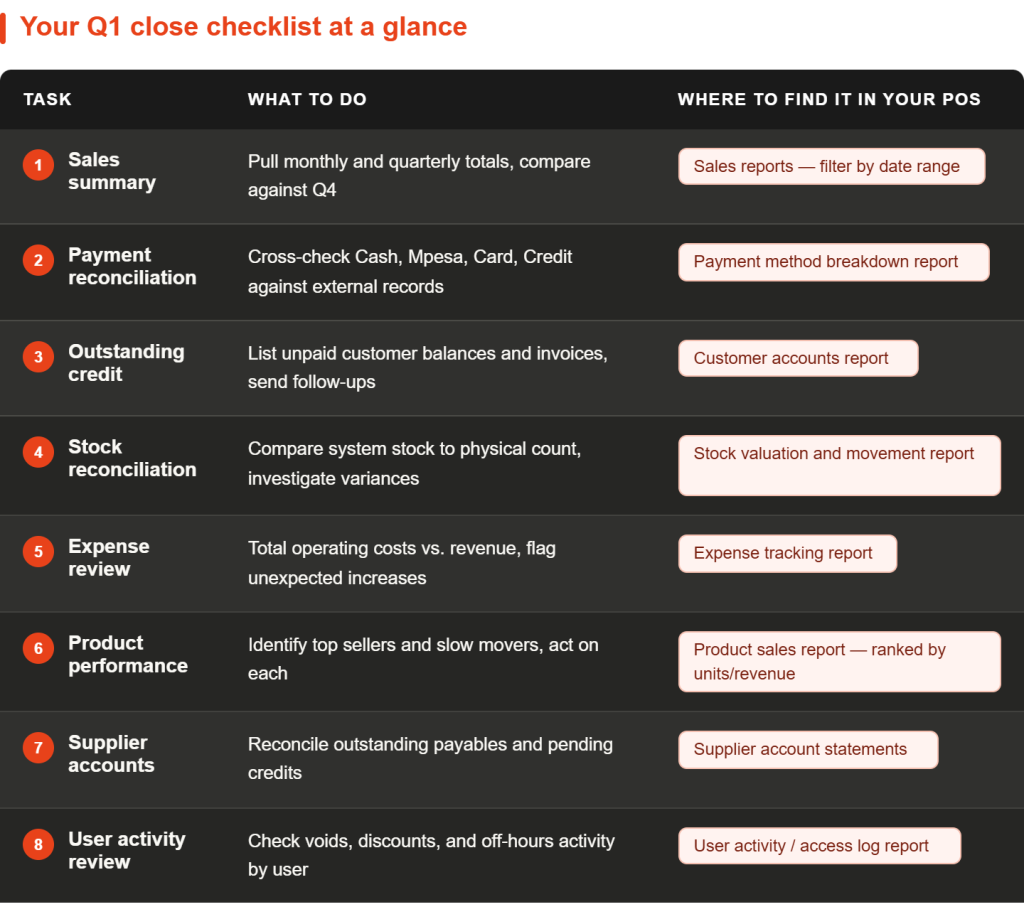
Here is a practical, step-by-step checklist to help you close Q1 cleanly and fast, using your POS system.

Step 1: Pull Your Sales Summary Report

Start with the big picture. Run a sales report filtered by date range for January, February, and March separately then pull a combined Q1 total. This gives you your gross sales, returns and refunds, and net revenue for the quarter.

Compare it against Q4 of last year. Were you up or down? By how much? Which month performed strongest? A single quarterly sales report gives you more insight into your business health than almost anything else, and it takes less than five minutes to generate.

Step 2: Reconcile Your Payment Methods

Your POS tracks every payment type, cash, Mpesa, credit card, credit sales, and invoices. At quarter-end, reconcile each channel against its external record:

  • Cash: Compare your POS cash totals against actual cash counted and banked over the quarter.
  • Mpesa: Cross-check your POS Mpesa records against your Mpesa business statement or till number history.
  • Credit card: Match against your bank or card terminal settlement reports.
  • Credit/invoices: Flag any transactions marked as unpaid.

Any unexplained gaps between what the POS recorded and what actually came in are a red flag and they are far easier to trace now than six months down the line.

Step 3: Chase Outstanding Credit and Unpaid Invoices

Quarter-end is the best time to recover money owed to you. Pull up your customer accounts report and list everyone with an outstanding balance. Do the same for unpaid invoices. Note how long each amount has been outstanding anything beyond 30 days needs a direct follow-up.

The end of a quarter is a natural business milestone that makes it easier to have these conversations with customers. A simple message or phone call with a clear deadline goes a long way. Do not let credit balances roll quietly into Q2.

Step 4: Conduct a Stock Reconciliation

Your POS records every sale and every purchase order received. Run a stock valuation report and compare what the system says you should have on the shelf against what is actually there. A physical count of your fast-moving items is ideal at minimum, spot-check your top 20 products by sales volume.

Any significant gap between system stock and physical stock is inventory shrinkage, and it needs investigating. Common causes include employee theft, supplier short-delivery, spoilage, and data entry errors. Catching this at quarter-end — not year-end — keeps the losses manageable.

Step 5: Review Your Expenses

If you have been logging business expenses in your POS throughout the quarter rent, utilities, supplies, staff costs pull that report now. Calculate your total operating expenses against your net revenue. What does your gross margin look like for Q1?

Look specifically for expense categories that grew unexpectedly compared to Q4. A 10% increase in one line item might be insignificant. A 40% jump in another could indicate a problem worth addressing before it compounds over the rest of the year.

Step 6: Identify Your Best and Worst Performers

Run a product performance report ranked by units sold and by revenue generated. This tells you two important things:

  • Your top sellers: Make sure these are never out of stock going into Q2. If any ran low during Q1, adjust your reorder points.
  • Your slow movers: Products that barely shifted all quarter are tying up your capital and your shelf space. Decide now do you discount to clear them, return them to the supplier, or discontinue them entirely?

Quarter-end is the right moment to make these decisions. Acting on slow-moving stock in April is far better than discovering it again in June.

Step 7: Reconcile Your Supplier Accounts

Check your supplier transaction history for Q1. Are there any outstanding balances you owe? Any credits owed to you from returns or disputed deliveries? Reconciling your supplier accounts quarterly prevents disputes from piling up, keeps your credit terms in good standing, and gives you a clearer picture of your payables as you plan Q2 cash flow.

Step 8: Review User Activity and Access Logs

A well-configured POS records every action taken by every user — who processed sales, who made voids, who approved discounts, and who ran returns. At quarter-end, review these logs. Look for:

  • Unusual void or refund patterns: A high number of voids by a single user is worth investigating.
  • Unauthorised discounts: Any discounts applied outside approved levels.
  • Off-hours transactions: Sales processed at unusual times that do not match your operating hours.

This is not about distrust it is about accountability. Reviewing access logs as a quarterly habit is one of the simplest ways to deter internal theft and maintain operational integrity. For a deeper look at how POS theft happens and how to prevent it, read our guide on POS security for African retailers.

The Bigger Picture: Your POS Is More Than a Till

A lot of business owners treat their POS as a way to ring up sales and print receipts. And while it does that job perfectly, the real value sits in the reports. Every transaction your system records is a data point that when reviewed regularly tells you exactly where your business stands and where it is going.

Closing your books at quarter-end is not just an administrative task. It is how you find the leaks before they become floods. It is how you spot opportunities before your competitors do. And it is how you walk into Q2 with confidence rather than guesswork.

The businesses that grow consistently in Nairobi’s competitive retail environment are not always the ones with the biggest budgets or the best locations. They are the ones where the owner knows their numbers — and uses them.

Q1 is done. Q2 starts fresh. Make sure you go into it with clean books, clear stock, and a plan.

The Ultimate Kenya Payment Guide 2026: Cash, M-Pesa & Card

Kenya has been called the world’s most cash-light economy — yet cash still dominates 8 out of 10 daily purchases. The full picture of how Kenyan shoppers pay in 2026 is more layered, more regional, and more commercially important than any single headline suggests.

Whether you run a supermarket in Nairobi, a hardware shop in Nakuru, or a restaurant in Mombasa, the payment methods you accept directly affect how many customers you can serve, and how much revenue you leave on the table.

Here’s what the data actually shows.

The 2026 Snapshot: Three Payment Worlds, One Market

Walk into a supermarket in Westlands and someone will tap a card. Hail a boda-boda in Eldoret and you’ll almost certainly hand over notes. Order from a kiosk in Kisumu and a phone will ping. Kenya’s payment landscape isn’t a single race with one winner — it’s three parallel systems, each dominant in its own lane.

The 2024 FinAccess Household Survey and Central Bank of Kenya data give us the clearest picture yet:

  • 79.8% of daily expenses are still paid in cash
  • 13.1% of daily expenses go through mobile money — almost entirely M-Pesa
  • Card POS payments reached KES 297 billion in 2025, with 61.7 million transactions recorded

These aren’t competing forces so much as complementary layers. What has shifted dramatically over the past two years is where each layer is growing — and what that means for businesses still accepting only one method.

Cash: Still King — But Quietly Receding

Despite every mobile-money headline, cash remains Kenya’s dominant payment method by a wide margin. In open-air markets, matatus, roadside dukas, and informal service providers, cash isn’t just accepted — it’s expected.

The reason is structural. Most Kenyan retail still happens in informal settings — wayside kiosks, produce markets, jua kali workshops — where POS machines are absent and mobile money fees on micro-transactions can feel punishing on the seller’s side. A KES 50 transaction doesn’t easily absorb a transfer fee.

That said, the direction of travel is clear. Cash handled by mobile money agents — the proxy for money being “cashed out” from digital wallets — fell 5.3% in 2025 to KES 8.2 trillion, down from KES 8.7 trillion the previous year. Consumers are increasingly keeping money digital for longer before converting to cash.

Who still prefers cash? Rural consumers, informal sector workers, older demographics, and anyone transacting in low-value, high-frequency contexts: market traders, food vendors, transport workers, and household staff. It’s also the universal fallback when mobile networks go down.

For business owners: Refusing cash in Kenya in 2026 is still commercially risky, particularly outside major urban centres. The right question isn’t “should we accept cash?” — it’s “how do we reconcile cash alongside our other channels efficiently?”


M-Pesa: The Backbone of Digital Kenya

If cash is Kenya’s legacy system, M-Pesa is its operating system. Launched in 2007, Safaricom’s platform has grown into something far beyond a payment tool — it’s national infrastructure. And 2025 figures confirm its position is more entrenched than ever.

M-Pesa by the numbers (2025/2026):

MetricFigure
Monthly active users37.9 million
Mobile money market share~90%
Registered merchant tills2.4 million
Active agents319,000+
Revenue contribution to Safaricom44% of total service revenues

One figure stands out: M-Pesa now has more monthly active users (37.9 million) than the Safaricom mobile network has subscribers (37.5 million). Mobile money has officially outgrown the telco that built it.

M-Pesa generated KES 88.1 billion in just the first half of Safaricom’s FY26 — outperforming mobile data, voice calls, and SMS combined. That commercial weight explains why the platform continues to receive heavy infrastructure investment, including a new Fintech 2.0 platform capable of processing up to 8,000 transactions per second.

Looking ahead, Safaricom is rolling out NFC “Tap to Pay” capabilities via mobile phones, wallet sharing features, AI-powered fraud detection, and deeper merchant analytics. M-Pesa’s role in retail commerce is about to deepen significantly.

Who prefers M-Pesa? Almost everyone, but particularly urban and peri-urban consumers aged 18–54, SME owners, freelancers, and anyone purchasing from a business with a merchant till number. Any business without a Buy Goods or Paybill number is already turning away the majority of digitally active shoppers.

Card Payments: The Slow-Burn Contender

Cards in Kenya have never had a viral moment. No single government mandate, no behavioural shock that turned the country card-first. Instead, cards have done something more durable: grown steadily, year on year, almost without interruption.

The 2025 data from the Central Bank of Kenya tells the latest chapter:

  • Card POS value: KES 297 billion (up from KES 291.9 billion in 2024)
  • POS transaction volume: 61.7 million (up 4.1%)
  • POS terminals deployed: 54,454 (up from 48,653 at end-2024)

Cards occupy a distinct lane in Kenya, they thrive where formality meets record-keeping. Supermarkets, fuel stations, hotel counters, pharmacies, mid-tier restaurants. The invisible hand nudging this growth: merchants typically absorb the interchange fee, making the payment feel costless to the buyer at point of swipe.

Visa holds approximately 56% of card brand share in Kenya, with Mastercard at 44%. Credit card penetration remains below 7% of the population — the growth is overwhelmingly in debit cards linked to bank accounts.

Who prefers cards? Formally employed Kenyans, business professionals, tourists, diaspora returnees, and consumers making mid-to-high-value purchases at organised retail outlets. Nairobi and Mombasa account for the majority of card transaction volume.

Side-by-Side: What Each Method Does Well

💵 Cash📱 M-Pesa💳 Card
Accepted across Kenya✅ Universal✅ Near-universal⚠️ Urban/formal only
Works offline✅ Always❌ Needs network❌ Needs network
Transaction record❌ None✅ SMS confirmation✅ Full digital record
Fee-free for merchant✅ Yes⚠️ Tiered fees⚠️ Interchange rate
Theft/fraud risk❌ High (theft)⚠️ Low-moderate⚠️ Low (chip+PIN)
Works for e-commerce❌ No✅ Paybill/API✅ Online payments
Speed at point of sale⚠️ Counting time✅ Fast (till/QR)✅ Fast (tap/swipe)
Reconciliation burden❌ High (manual)⚠️ Medium✅ Low (auto)

What’s Actually Shifting in 2026

1. High-value retail is migrating to cards

Mobile money agent data from 2025 revealed a telling pattern: total cash value handled by agents fell 5.3%, yet transaction volumes rose 2.5%. Average ticket sizes are shrinking. Consumers aren’t abandoning mobile money — they’re using it more frequently for smaller purchases, while larger transactions increasingly route through bank cards. Groceries above KES 5,000. Electronics. Fuel. Travel. These are becoming card-first categories in urban centres.

2. M-Pesa’s merchant network is the largest in Kenyan financial history

With 2.4 million merchant tills and over 319,000 active agents, M-Pesa’s physical footprint is larger than all other Kenyan financial institutions combined. Not being integrated is no longer a minor gap — it’s a structural competitive disadvantage.

3. Contactless and NFC are converging the two digital channels

Safaricom’s Fintech 2.0 platform is laying the groundwork for NFC-based tap-to-pay from mobile phones. Combined with the steady growth of contactless card terminals, the distinction between mobile money and card payments is about to blur. A customer in 2027 may tap their phone for a KES 2,000 restaurant bill — and it might route through either channel depending on their wallet settings.


How PawaPOS Helps You Accept All Three

The data makes one thing clear: Kenyan shoppers don’t have a single preferred payment method. They switch based on context, habit, and what’s convenient in the moment.

PawaPOS is built around that reality. Accept M-Pesa (Lipa Na Buy Goods and Paybill), Visa and Mastercard, and cash, all from one unified system. Every transaction, regardless of method, flows into the same dashboard for real-time reconciliation.

No more separate till records for cash. No more cross-referencing M-Pesa SMS confirmations with your sales log. No lost sales because a customer’s preferred method isn’t supported.

Multi-Payment

Every way
Kenyans pay,
in one place.

Stop turning away customers because of how they want to pay. PawaPOS unifies M-Pesa, card, and cash into a single checkout — with real-time reconciliation across all methods.

Explore PawaPOS
No setup fees
Free training
Works offline
📲

M-Pesa Lipa Na

Buy Goods & Paybill — instant confirmation, zero manual reconciliation.

💳

Visa & Mastercard POS

Tap, swipe or insert — all card payments logged automatically to your dashboard.

💵

Cash with Float Tracking

Automatic float management — track every note in and out with full audit trail.

📊

Unified Sales Dashboard

All payment methods in one view — no spreadsheets, no end-of-day guesswork.

Real-Time Confirmation

Every payment confirmed instantly — no delays, no disputes, no lost receipts.

🔄

Offline & Auto-Sync

Keep selling during outages. All transactions sync automatically when you reconnect.

Accepts M-PESA VISA MASTERCARD CASH

E-TIMS 2026: What Every Kenyan Retailer Must Know

If you run a shop, supermarket, bar, or any retail business in Kenya, 2026 is not the year to look the other way on tax compliance. The Kenya Revenue Authority (KRA) has rolled out a sweeping new digital enforcement framework, and at the centre of it all is E-TIMS — the Electronic Tax Invoice Management System.

Whether you already use it or are hearing about it for the first time, this guide breaks down exactly what E-TIMS is, why it matters more than ever in 2026, and the practical steps your business needs to take to stay on the right side of KRA.

⚡ The Big Change in 2026

From January 1, 2026, KRA automatically cross-checks every tax return you file against your E-TIMS invoices. Any expense not backed by a valid E-TIMS invoice can be disallowed — meaning it becomes taxable income. This is not a future threat. It is happening now.

1. What Is E-TIMS?

E-TIMS (Electronic Tax Invoice Management System) is KRA’s digital invoicing platform that requires businesses to generate, transmit, and store all tax invoices electronically — in real time.

Think of it as a direct digital link between your business and KRA. Every time you make a sale and issue an invoice, that invoice is transmitted to KRA’s servers automatically.

A brief history of how we got here:

  1. 2005 — KRA introduced Electronic Tax Registers (ETRs) to track VAT.
  2. 2021 — TIMS launched, integrating ETR machines with iTax.
  3. 2023 — The Finance Act made E-TIMS mandatory for ALL businesses, not just VAT-registered ones.
  4. 2024 — Regulations gazetted; the KSh 5 million exemption was scrapped entirely.
  5. 2026 — Automated validation begins. Every return is now cross-checked against E-TIMS data.

2. Who Needs to Comply?

Short answer: virtually every business in Kenya. The common myths have now been busted:

Common MythThe Reality
"I'm not VAT registered, so I'm exempt"Not anymore. ALL businesses must register regardless of VAT status.
"My turnover is below KSh 5 million"The KSh 5 million exemption has been scrapped. Every business must comply.
"I'm too small for KRA to notice"KRA's automated system validates returns digitally — size does not protect you.
"I'll sort it out during filing season"Compliance starts at the point of sale. Retroactive fixes are costly and risky.

3. What Exactly Changed in January 2026?

From January 1, 2026, KRA introduced automated cross-validation of tax returns. When you file on iTax, the system checks your declared figures against three sources:

  • Your E-TIMS invoice records — all sales you issued invoices for
  • Withholding tax data — amounts deducted from or paid by you
  • Customs import records — goods brought in from abroad

Real-world example: A minimart owner buys stock worth KSh 800,000 from a supplier not on E-TIMS. When that expense is claimed, KRA flags it — no matching invoice. The expense is disallowed, and the owner pays tax as if they earned KSh 800,000 more than they did.

It’s not just your compliance that matters — it’s the compliance of every supplier you buy from.

4. What Happens If You Don't Comply?

  • Disallowed expenses: Purchases without E-TIMS invoices are rejected as deductibles — raising your taxable income automatically.
  • Return rejections: KRA can reject your return even after you’ve paid your taxes.
  • Financial penalties: The penalty is twice the tax due.
  • Tax audits: Discrepancies flag your business for closer scrutiny.
  • Loss of TCC: No Tax Compliance Certificate means no government tenders, no import clearances, difficulty renewing licences.
  • Lost customers: More buyers are demanding E-TIMS invoices. Businesses that can’t provide them are losing contracts.

5. How Do You Get Started with E-TIMS?

Step 1 — Visit the eTIMS Portal:
Go to etims.kra.go.ke and click Sign Up. You’ll need your KRA PIN and access to your iTax-registered phone number for an OTP.

Step 2 — Choose your solution:
Options include the eTIMS Client (desktop), eTIMS Web Portal, eTIMS Lite via USSD, or system-to-system integration for businesses with existing software.

Step 3 — Integrate with your POS:
Connect E-TIMS directly to your point-of-sale system so invoices are transmitted automatically at each sale — zero manual effort.

Step 4 — Capture buyer PINs:
For all B2B transactions, include the buyer’s KRA PIN on the invoice.

Step 5 — Reconcile monthly:
Don’t wait until filing season. Confirm all invoices are transmitting correctly every month.

6. How PawaPOS Makes E-TIMS Compliance Seamless

For Kenyan retailers using PawaPOS, E-TIMS compliance is built directly into the system — no separate workflow, no separate device, no separate login.

Every time a sale is processed, PawaPOS automatically generates an E-TIMS-compliant invoice and transmits it to KRA in real time:

  • No manual uploads at the end of the day
  • Every sale recorded and transmitted — even across multiple branches
  • Your PawaPOS records always match what KRA sees
  • Tax season reconciliation is already done

For supermarkets, bars & restaurants, wine & spirits shops, and general merchants — PawaPOS is designed around how Kenyan retail actually works: M-Pesa, multi-store stock, and offline invoicing included.

7. Quick Compliance Checklist

Done?Action Item
Registered on eTIMS portal with your KRA PIN
Chosen an eTIMS solution that fits your business
Integrated eTIMS with your POS or billing system
All sales invoiced and transmitted to KRA automatically
Capturing buyer KRA PINs on all B2B invoices
Verifying key suppliers are eTIMS-compliant
Running monthly reconciliations between POS and eTIMS records
Updated Tax Compliance Certificate (TCC) with KRA
Finance team aware of 2026 validation rules and implications

The Bottom Line

E-TIMS compliance in 2026 is not optional, and it’s not just a back-office task for your accountant. It starts at the point of sale — every transaction, every day. Retailers who get this right avoid penalties and gain cleaner records, smoother tax filing, and the credibility of being fully compliant.

The question is no longer whether to comply. It’s whether your current setup makes compliance happen automatically, every time.

Want to see how PawaPOS handles E-TIMS for your business?

Book a free demo today and we'll walk you through how our built-in E-TIMS integration keeps you compliant — automatically.

📞 +254 710 901 965  |  ✉ hello@cosmopawa.com  |  cosmopawa.com

Note: This article is for informational purposes only. For specific tax advice, consult a certified tax professional or visit kra.go.ke.