

Q1 is wrapping up. For many Kenyan business owners — whether you run a minimart, a wine & spirits shop, a bar, or a general merchandise store — the end of March brings a familiar mix of relief and dread. Relief that the quarter is done. Dread because now you have to make sense of everything that happened over the past three months.
Receipts to reconcile. Stock to verify. Expenses to account for. Reports to pull together. In fact, for businesses still running on manual systems or basic spreadsheets, this process can eat up days of your time. As the Kenya Revenue Authority requires businesses to maintain accurate financial records, getting your books in order at quarter-end is not just good practice — it is a legal obligation.
However, if you have a POS system, the good news is: the work is largely already done. The data is there. The reports are waiting. Furthermore, unlike manual methods, a modern POS gives you instant access to everything you need in one place. You just need to know what to look for — and in what order. As a result, what used to take days can now take a few focused hours. According to Safaricom’s SME business resources, integrated digital tools are one of the biggest drivers of efficiency for small and medium businesses in Kenya — and your POS is exactly that.
Also available as a podcast
Quarter-End Secrets: The 8-Step POS Checklist Every Kenyan Retailer Needs
Cosmo Pawa · Listen on Spotify
Here is a practical, step-by-step checklist to help you close Q1 cleanly and fast, using your POS system.
Step 1: Pull Your Sales Summary Report
Start with the big picture. Run a sales report filtered by date range for January, February, and March separately then pull a combined Q1 total. This gives you your gross sales, returns and refunds, and net revenue for the quarter.
Compare it against Q4 of last year. Were you up or down? By how much? Which month performed strongest? A single quarterly sales report gives you more insight into your business health than almost anything else, and it takes less than five minutes to generate.
Step 2: Reconcile Your Payment Methods
Your POS tracks every payment type, cash, Mpesa, credit card, credit sales, and invoices. At quarter-end, reconcile each channel against its external record:
- Cash: Compare your POS cash totals against actual cash counted and banked over the quarter.
- Mpesa: Cross-check your POS Mpesa records against your Mpesa business statement or till number history.
- Credit card: Match against your bank or card terminal settlement reports.
- Credit/invoices: Flag any transactions marked as unpaid.
Any unexplained gaps between what the POS recorded and what actually came in are a red flag and they are far easier to trace now than six months down the line.
Step 3: Chase Outstanding Credit and Unpaid Invoices
Quarter-end is the best time to recover money owed to you. Pull up your customer accounts report and list everyone with an outstanding balance. Do the same for unpaid invoices. Note how long each amount has been outstanding anything beyond 30 days needs a direct follow-up.
The end of a quarter is a natural business milestone that makes it easier to have these conversations with customers. A simple message or phone call with a clear deadline goes a long way. Do not let credit balances roll quietly into Q2.
Step 4: Conduct a Stock Reconciliation
Your POS records every sale and every purchase order received. Run a stock valuation report and compare what the system says you should have on the shelf against what is actually there. A physical count of your fast-moving items is ideal at minimum, spot-check your top 20 products by sales volume.
Any significant gap between system stock and physical stock is inventory shrinkage, and it needs investigating. Common causes include employee theft, supplier short-delivery, spoilage, and data entry errors. Catching this at quarter-end — not year-end — keeps the losses manageable.
Step 5: Review Your Expenses
If you have been logging business expenses in your POS throughout the quarter rent, utilities, supplies, staff costs pull that report now. Calculate your total operating expenses against your net revenue. What does your gross margin look like for Q1?
Look specifically for expense categories that grew unexpectedly compared to Q4. A 10% increase in one line item might be insignificant. A 40% jump in another could indicate a problem worth addressing before it compounds over the rest of the year.
Step 6: Identify Your Best and Worst Performers
Run a product performance report ranked by units sold and by revenue generated. This tells you two important things:
- Your top sellers: Make sure these are never out of stock going into Q2. If any ran low during Q1, adjust your reorder points.
- Your slow movers: Products that barely shifted all quarter are tying up your capital and your shelf space. Decide now do you discount to clear them, return them to the supplier, or discontinue them entirely?
Quarter-end is the right moment to make these decisions. Acting on slow-moving stock in April is far better than discovering it again in June.
Step 7: Reconcile Your Supplier Accounts
Check your supplier transaction history for Q1. Are there any outstanding balances you owe? Any credits owed to you from returns or disputed deliveries? Reconciling your supplier accounts quarterly prevents disputes from piling up, keeps your credit terms in good standing, and gives you a clearer picture of your payables as you plan Q2 cash flow.
Step 8: Review User Activity and Access Logs
A well-configured POS records every action taken by every user — who processed sales, who made voids, who approved discounts, and who ran returns. At quarter-end, review these logs. Look for:
- Unusual void or refund patterns: A high number of voids by a single user is worth investigating.
- Unauthorised discounts: Any discounts applied outside approved levels.
- Off-hours transactions: Sales processed at unusual times that do not match your operating hours.
This is not about distrust it is about accountability. Reviewing access logs as a quarterly habit is one of the simplest ways to deter internal theft and maintain operational integrity. For a deeper look at how POS theft happens and how to prevent it, read our guide on POS security for African retailers.
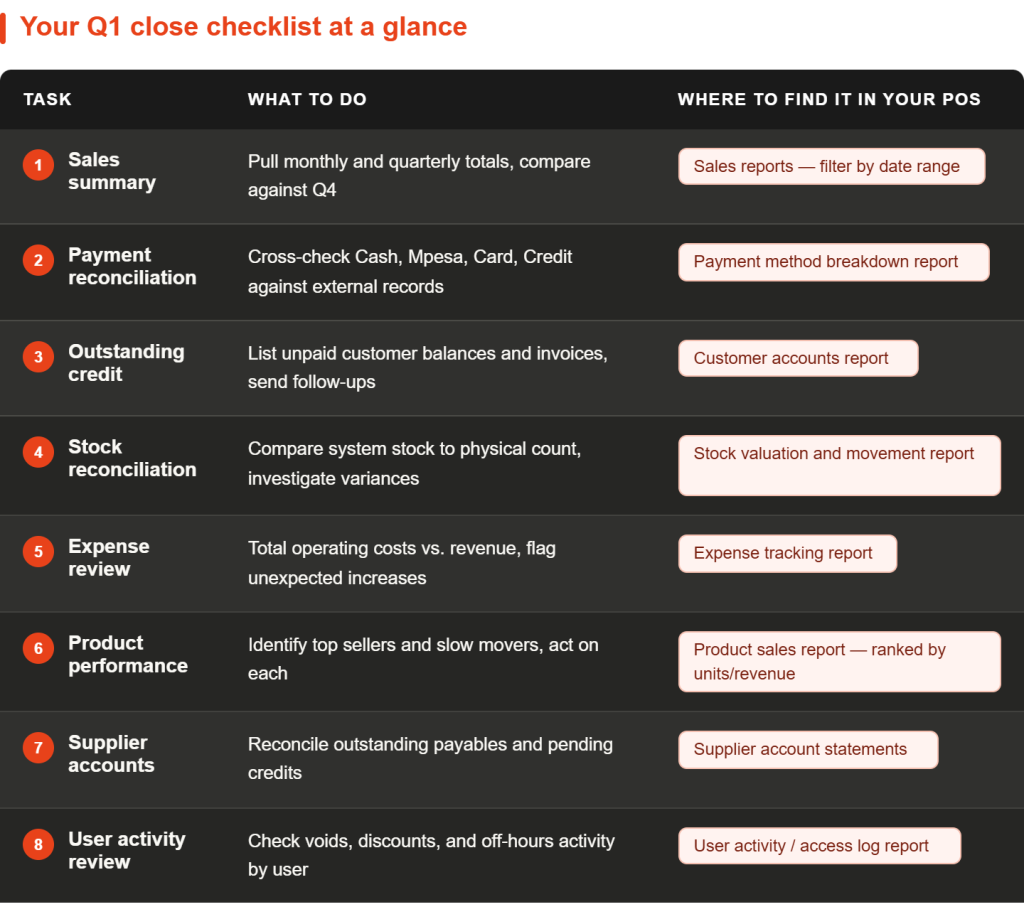
The Bigger Picture: Your POS Is More Than a Till
A lot of business owners treat their POS as a way to ring up sales and print receipts. And while it does that job perfectly, the real value sits in the reports. Every transaction your system records is a data point that when reviewed regularly tells you exactly where your business stands and where it is going.
Closing your books at quarter-end is not just an administrative task. It is how you find the leaks before they become floods. It is how you spot opportunities before your competitors do. And it is how you walk into Q2 with confidence rather than guesswork.
The businesses that grow consistently in Nairobi’s competitive retail environment are not always the ones with the biggest budgets or the best locations. They are the ones where the owner knows their numbers — and uses them.
Q1 is done. Q2 starts fresh. Make sure you go into it with clean books, clear stock, and a plan.