

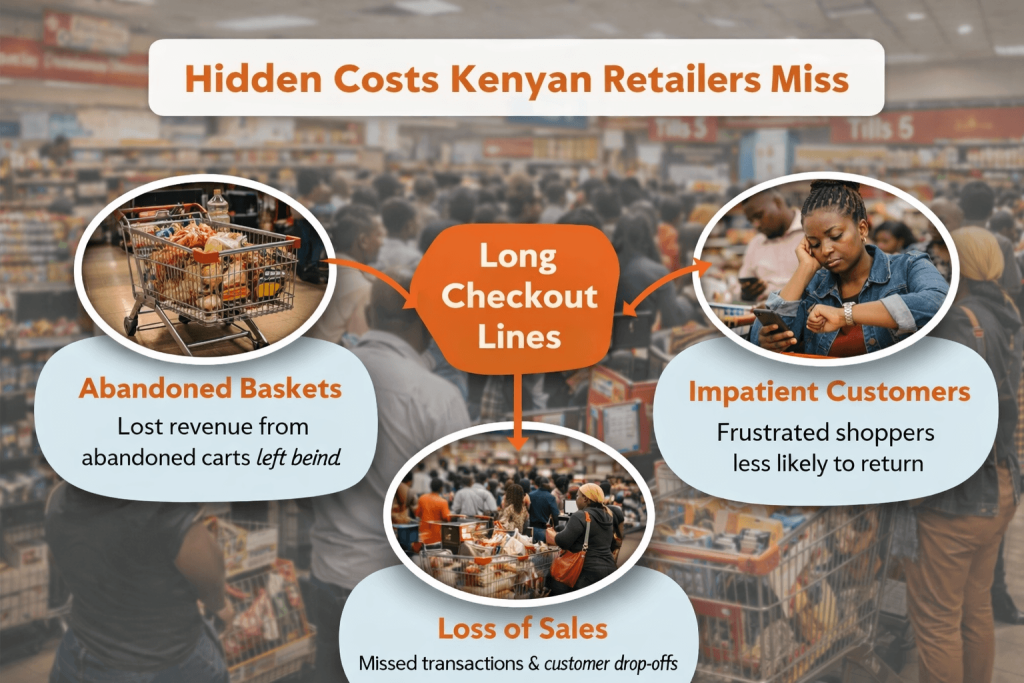
Every retailer knows the frustration: customers walk in, fill their baskets, then abandon their purchases at the checkout line. It’s a silent profit killer happening in retail stores across Kenya, costing businesses thousands of shillings daily, and most don’t even realize it’s happening.
Martha Mbugua, a retail operations leader, put it perfectly: “A customer can forgive an out-of-stock item. They rarely forgive a long checkout queue.” Yet many retailers still treat their checkout as an afterthought, focusing on merchandising while losing customers at the final, most crucial step.
The checkout isn’t just where transactions happen, it’s where customers decide if they’ll return. And right now, outdated systems are bleeding your profits in ways you might not see on your daily reports.
The Real Cost of Slow Checkouts
Picture this: It’s Saturday afternoon at your store. Five customers are waiting in line, each holding items worth KES 2,500. Your cashier is manually entering prices, the customer disputes an amount, the till drawer jams, and an M-Pesa payment needs manual confirmation.
By the time you look up, two customers have left, taking KES 5,000 in lost sales with them. And they probably won’t be back.
Fast checkout isn’t a luxury, it’s a competitive advantage. When your competitors can process a transaction in 30 seconds while yours takes 3 minutes, you’re not just losing sales. You’re losing customers to businesses that respect their time.
Modern POS systems like PawaPos eliminate these bottlenecks through:
- Lightning-fast barcode scanning – No more manual price entry
- Instant M-Pesa verification – Payments confirmed in seconds, not minutes
- Multi-payment options – Cash, card, M-Pesa, all in one smooth flow
- Automatic calculations – Zero pricing disputes or manual errors
The math is simple: If you process just 10 extra transactions per day because checkout is faster, at an average basket of KES 1,500, that’s KES 15,000 daily, KES 450,000 per month in recovered sales.
The Silent Thief: Retail Shrinkage
Here’s what keeps retail owners up at night: You’re making sales, inventory is moving, but your profits don’t match the math. The culprit? Retail shrinkage—and manual systems make it almost impossible to detect.
Shrinkage comes in three forms:
1. Customer Theft
Without proper tracking, shoplifters walk out with merchandise that never appears on your loss reports. You only notice when stock counts don’t match sales—often weeks or months later.
2. Employee Fraud
Manual tills create opportunity. A cashier undercharges a friend, pockets the difference, or voids legitimate transactions. With no digital trail, these losses are nearly invisible until they’ve cost you thousands.
3. Administrative Errors
Wrong prices entered, incorrect quantities recorded, missing receipts—small mistakes that add up to significant losses over time.
The Kenya reality: Studies show retail shrinkage typically costs businesses 1-3% of total sales. For a store doing KES 2 million monthly, that’s up to KES 60,000 disappearing every month.
Modern POS systems stop shrinkage by creating complete accountability:
- ✅ Every item scanned – No manual price entry means no “friendly discounts”
- ✅ Digital transaction trail – Every sale, void, and refund is timestamped and tracked
- ✅ Real-time inventory sync – Stock levels update instantly, making discrepancies obvious
- ✅ User-level permissions – Track exactly who processed which transactions
- ✅ Automatic reconciliation – Cash drawer amounts match sales reports to the shilling
The impact? Retailers using modern POS systems typically reduce shrinkage by 40-60%, recovering tens of thousands in monthly losses.
The M-Pesa Verification Gap
If you’re still relying on customer SMS screenshots for M-Pesa payments, you’re leaving money on the table, and exposing yourself to fraud.
Here’s what’s happening in Kenyan retail right now:
The Old Way (Still Used by Many):
- Customer claims they’ve sent M-Pesa
- They show you an SMS screenshot
- You trust it and release the goods
- Later, you realize the payment never arrived
The Modern Way with PawaPos:
- Customer selects M-Pesa payment
- System sends STK push to customer’s phone
- Payment is verified in real-time through API
- Transaction only completes when payment is confirmed
- Instant receipt generated
No screenshots. No trust issues. No fraud. Just verified, instant payments.
What Checkout Excellence Actually Looks Like
“Efficient checkouts come from discipline, not urgency:
— Martha Mbugua, Retail Operations Leader
• Planning staffing around traffic patterns, not schedules
• Opening tills before queues form
• Clear front-end ownership during peak hours
• Leaders actively managing flow in real time”
She’s absolutely right—but here’s what she didn’t mention: Great operations need great technology.
This is where PawaPos gives Kenyan retailers the edge:
⚡
Sub-3-Second Transactions
From scan to receipt, the entire process is lightning-fast. No lag, no waiting, no frustrated customers.
📊
Real-Time Peak Hour Detection
The system shows you live traffic patterns, helping you decide when to open additional tills—before the queue forms.
💪
Offline-First Architecture
Kenya’s internet isn’t always reliable. PawaPos keeps working even when connectivity drops, syncing automatically when it’s restored.
📱
Mobile POS Option
During peak times, turn any Android device into an additional checkout point. Process sales from anywhere in your store.
The Real-World Impact: A Nairobi Case Study
Before PawaPos:
- Average checkout time: 4.5 minutes
- Shrinkage: KES 40,000/month
- M-Pesa fraud: 2-3 incidents/month
- Abandoned baskets: 15-20%
- Monthly revenue: KES 2.2 million
After PawaPos:
- Average checkout time: 45 seconds ✅
- Shrinkage: KES 14,000/month ✅
- M-Pesa fraud: Zero ✅
- Abandoned baskets: Less than 5% ✅
- Monthly revenue: KES 2.8 million ✅
27% revenue increase!
Stop the Bleeding: Take Action Today
The question isn’t whether you can afford a modern POS system—it’s whether you can afford to keep losing money without one.
Ready to stop losing money at checkout?
📧 Email: info@cosmopawa.com
🏢 Visit Us:
Cosmo House, Mawe Mbili Road
(off Kangundo Road), Nairobi
Business Hours:
Monday – Friday: 8:00 AM – 6:00 PM
Saturday: 9:00 AM – 2:00 PM EAT
PawaPos is proudly Kenyan, built specifically for East African retailers. We understand your challenges because we work with businesses just like yours every day, from small shops to supermarket chains across Nairobi, Mombasa, Kisumu, and beyond.
Proudly Local. Powerfully Retail.