
Retail worker in a dim store uses a touchscreen POS tablet at the counter, with orange neon cloud data trails emanating from the screen.

Retail Data Backup in Kenya: Protect Sales, Stock, and Customers

Most Kenyan retail owners know their POS system is the heart of the business. But what happens when that heart stops — because the data it runs on simply disappears? Data backup for retail businesses is not a luxury. It is the difference between recovering from a crisis and shutting down permanently.

Picture this: It’s a busy Friday evening at your shop along Thika Road. Sales are flying, your POS is humming, stock is moving fast. Then — the lights go out. KPLC again. When power comes back an hour later, your POS system boots up with an error. Today’s 200-plus transactions? Gone. Your updated stock levels? Wiped. That supplier order you were finalising? Lost.

For thousands of Kenyan SME owners — in retail, bars, and restaurants — this is not a hypothetical. It is a Tuesday. And the retailers who survive it are the ones who had a data backup strategy in place before the disaster struck.

This week, we are talking about an unusual topic. Not sales. Not stock management. Not M-Pesa integration. We are talking about backups — and why ignoring this one discipline can undo everything else you have built in your business.

The Scale of the Problem — and Why Kenya Is Especially Exposed

Data loss is a global problem, but Kenyan businesses face a version of it that is uniquely challenging. While the rest of the world mostly worries about cyberattacks and software failures, Kenyan SMEs have all of that plus one of the world’s least predictable power grids.

Kenya Power reported over 1,200 outages in Nairobi alone in 2024 — some planned, most not. A small business in Westlands could lose 50 hours a year to blackouts, costing KES 100,000 in wasted wages and missed business.

Virtual Office Point, 2025

Now factor in that most small retail businesses in Kenya still run their POS on a local machine — a single computer, one hard drive, zero redundancy. When power surges, that machine is your single point of failure. When it dies, it takes everything with it: sales history, inventory counts, customer records, supplier pricing, and the audit trail your accountant needs at month-end.

One Nairobi CBD retailer experienced a stock system crash that wiped out an entire month of sales records. With no backup, recovery was not possible — the estimated loss was KES 200,000. That is not a tech problem. That is a business problem that started as a preparedness problem.

Globally, the numbers are equally sobering:

  • The most common cause of data loss is hardware failure — responsible for 44% of all incidents, followed by human error at 32%.
  • Small businesses lose an average of KES 180,000 (USD 1,410) per minute of system downtime.
  • Over 60% of small and mid-sized businesses that suffer severe data loss shut down within six months.
  • 93% of organisations that experience prolonged data loss lasting ten days or more go bankrupt within a year.

Read that last one again. Ninety-three percent. This is not about inconvenience. This is an existential business risk.

What Data Is Actually at Risk in a Retail Business?

When most shop owners hear “data backup,” they think of computer files — Word documents, Excel sheets. But for a retail business running a POS system, the data that really matters is far more specific and far more critical.

Data TypeWhat It ContainsImpact if Lost
Transaction RecordsEvery sale, payment method, cashier, timestampRevenue disputes, KRA compliance gaps, no end-of-day reconciliation
Inventory DataStock levels, product codes, reorder pointsInability to restock accurately, ghost inventory, supplier disputes
Customer RecordsCredit accounts, purchase history, loyalty dataLost credit balances, broken customer relationships
Pricing & Product CatalogueSKUs, prices, categories, barcode mappingsManual re-entry of hundreds of products — weeks of work
Financial ReportsDaily Z-reports, sales summaries, profit marginsBlind spots in business performance, accounting errors
Staff & Access LogsCashier sessions, discounts, voids, overridesNo accountability trail, theft investigations impossible

Each of these data types took years to build. Losing them does not just hurt operations for a day — it can set your business back by months, or erase it entirely. Re-entering an entire product catalogue after a hard drive crash can take three weeks and cost at least KES 80,000 in staff time alone — not counting lost sales while the system is down.

PawaPOS Stores Your Data Safely — Even When the Lights Go Out

Cloud-first architecture means your sales, stock, and reports are protected automatically. Want to see how it works for your business?

The 3-2-1 Backup Rule — The Gold Standard Your Business Needs to Know

If you take only one thing from this article, make it this: the 3-2-1 backup rule. Recognised by IT security professionals and cybersecurity bodies worldwide as the baseline standard for data protection, it is simple enough to remember and robust enough to protect you from almost every common data loss scenario.

Here is what the 3-2-1 rule means in plain terms:

  • 3 — Maintain three copies of your data. The original plus two backups. Redundancy is the point.
  • 2 — Store them on two different storage types. For example, a local hard drive AND cloud storage — not two USB drives sitting in the same drawer.
  • 1 — Keep one copy stored off-site. In the cloud or at another physical location. If your shop burns down, this copy survives.

For a Kenyan retail business, a practical 3-2-1 setup looks like this:

  • Copy 1 (Live): Your active POS database — the data your system is working with right now.
  • Copy 2 (Local backup): An automatic backup to a separate device in your shop — an external hard drive or a local server. This gives you fast recovery if just the main machine fails.
  • Copy 3 (Cloud backup): A second backup that pushes your data to a secure cloud server automatically — so that even if your shop is flooded, burned, or burglarised, your records survive and you can restore from any device with internet access.

💡 The Kenyan context: Local backups give you fast recovery when KPLC cuts the power and your machine crashes. Cloud backups protect you from the scenarios that local backups cannot — fire, theft, or a total hardware write-off after a power surge. You need both.

Why “The Computer Has Everything” Is the Most Dangerous Sentence in Retail

Walk into many small retail shops in Nairobi — whether in Eastleigh, Ngong Road, or River Road — and ask the owner where their sales data lives. The answer is almost always some version of: “It’s in the computer.”

That single computer is handling sales, managing inventory, running reports, and storing years of transaction history. It has no backup. No redundancy. No plan for when it stops working. And it will stop working — hard drives have a finite lifespan, power surges are frequent, theft happens, and ransomware attacks are increasingly targeting small businesses in Kenya.

Consider the full picture of what can go wrong:

  • Power surges: A single voltage spike from a KPLC fault can fry a motherboard and corrupt storage simultaneously — wiping data that even a professional data recovery specialist cannot retrieve.
  • Ransomware: Cybercriminals increasingly target SMEs because they know small businesses lack enterprise-grade security. If ransomware encrypts your POS database, you either pay the ransom or lose everything — unless you have a clean backup.
  • Staff errors: Accidental deletion, database corruption during an update, or a staff member running the wrong operation can destroy records just as effectively as any hardware fault.
  • Physical disasters: A small fire in a stockroom, a burst pipe, or even a break-in that results in stolen hardware can wipe your only copy of years of business data in minutes.

Is Your Business Data Protected Against All of These Risks?

PawaPOS is built cloud-first — your data is backed up automatically, without you needing to remember to do anything. Let us show you how.

Cloud vs. Local Backup — What Every Kenyan SME Should Know

The debate between local and cloud backup is not an either/or question. It is a both question. But understanding what each option protects you from — and what it does not — is essential for smart business decisions.

Local Backup

A local backup is a copy of your data stored on a device in your premises — an external hard drive, a USB drive, or a network-attached storage (NAS) device. The advantages are speed and accessibility: if your main machine fails, you can restore from a local backup within minutes without needing internet access. This is critical in areas with unreliable connectivity.

The weakness: local backups are physically co-located with your primary data. If the shop floods, burns, or is robbed, both copies disappear together.

Cloud Backup

A cloud backup stores a copy of your data on remote servers — in a data centre that may be in Nairobi, Johannesburg, or further afield. The advantages are geographic separation (a disaster at your premises cannot reach it), automatic scheduling (no one needs to remember to plug in a hard drive), and accessibility from any device anywhere.

For Kenyan SMEs, the main consideration is internet connectivity — cloud backup relies on a stable enough connection to push updates regularly. In areas with poor connectivity, the backup schedule may lag.

The Hybrid Approach — What We Recommend

The most resilient setup for a Kenyan retail SME combines both: a local backup for fast, on-site recovery from everyday incidents, and a cloud backup as the disaster-recovery layer for scenarios where local copies are compromised or physically destroyed. This is exactly the 3-2-1 principle in practice.

What a Good POS Backup System Should Do Automatically

A backup system worth its name should operate without manual intervention. If your staff have to remember to click “backup” before closing, the backup will eventually get missed. Automation is the only reliable backup. Here is what to look for:

  • Scheduled automatic backups — Your data should be backed up at regular intervals throughout the day, not just at closing time.
  • Incremental backups — Rather than copying the entire database every time, a good system copies only the changes since the last backup. Faster and more efficient.
  • Off-site cloud sync — Automatically push backups to the cloud after each session. This happens in the background without slowing down POS operations.
  • Easy restoration — A backup is only valuable if you can restore from it quickly. The process should not require an IT specialist.
  • Multi-branch support — Each branch should back up its data independently to the same centralised system, so head office always has a complete picture.
  • Backup verification — The system should confirm that backups completed successfully. A failed backup that no one notices is no backup at all.

How PawaPOS Approaches Data Backup and Business Continuity

PawaPOS is built cloud-first, which means the backup architecture is baked into the foundation — not bolted on as an afterthought. Every transaction processed through PawaPOS is stored in a cloud database that is geographically separated from your local hardware.

When the lights go out in your shop — and in Kenya, they will — your transaction history, inventory state, and customer records remain safe and accessible. When power comes back, your system restores to the last known state automatically. No manual intervention. No lost data. No weeks of re-entry work.

For businesses that want an additional layer of protection, the PawaPOS backup module supports scheduled local exports and optional cloud storage integration — giving you the full 3-2-1 architecture without needing a dedicated IT team to manage it.

Your data should survive anything that happens to your hardware. Because your hardware is replaceable. Your data is not.

🔗 Learn more about how PawaPOS manages your retail data: cosmopawa.com — or explore our retail operations blog for more practical guides for Kenyan SMEs.

Final Thoughts

Data backup is one of those topics that feels abstract — until the day you desperately need it and do not have it. By then, the conversation is no longer about cost or convenience. It is about survival.

For Kenyan retail businesses operating in an environment of frequent power outages, aging infrastructure, rising cybercrime, and fierce market competition, a backup strategy is not a luxury. It is as fundamental as having a lock on your front door.

The 3-2-1 rule gives you a framework. Cloud-first POS software removes the burden of manual management. And understanding exactly what data your retail business runs on — transactions, inventory, pricing, customer records — gives you the motivation to protect it properly.

Your biashara has taken years to build. Do not let a single power surge, a stolen laptop, or a software fault take it down in a day.

Talk to the PawaPOS team today — and let us show you how your business data can be protected, automatically, starting from day one.

Protect Your Retail Business Data With PawaPOS

Cloud-backed, automatic, and built for the realities of running a business in Kenya.

A smiling shopkeeper hands snacks to a customer at a small street-side kiosk, jars and bags of goodies on display inside the blue-framed stall.

5 Ways Small Retailers Outsmart Kenya’s Supermarket Giants

There is probably a Naivas or a Quickmart near you. And if there isn’t one yet, there likely will be soon. Kenya’s two largest supermarket chains, Naivas with over 113 branches and Quickmart now past 63 store, are no longer just anchoring big malls. They are actively targeting middle-income residential estates and neighbourhood centres, looking for the same customers who walk into your shop every day. So what does a small or mid-sized retailer do when a supermarket opens 200 metres away?

The honest answer is: you don’t try to out-Naivas Naivas. You out-neighbour them. Here’s how.

Why the Big Chains Are Moving Into Your Street

Until recently, supermarket expansion in Kenya was largely driven by major shopping malls. That strategy is shifting. According to Knight Frank’s H2 2025 retail report, leading chains including Naivas, Quickmart, and Carrefour are now deliberately targeting neighbourhood centres and mixed-use community developments rather than large regional malls. The reason is simple: urban sprawl has pushed Kenya’s middle-income consumer further from traditional commercial hubs. The chains are following the customers.

At the same time, the rise of discount and budget retailers, China Village, China Square, Love Home Mart, and Panda Mart is applying price pressure from below. The result is a retail market being squeezed from two directions: scale at the top, price undercutting at the bottom.

For the independent neighbourhood shop or growing mini-mart, this is uncomfortable. But it is also clarifying. Because the one thing neither a 10,000 sq ft supermarket nor a discount chain can reliably offer is what your regulars already have with you: a relationship.

What Supermarkets Can’t Take from You

Dukas and independent retailers still account for roughly 70% of Kenya’s retail sales. That number is not an accident, it reflects something structural about how Kenyans shop. Proximity, trust, and flexibility matter enormously, especially outside Nairobi’s CBD.

The things a well-run independent shop can do that a supermarket cannot:

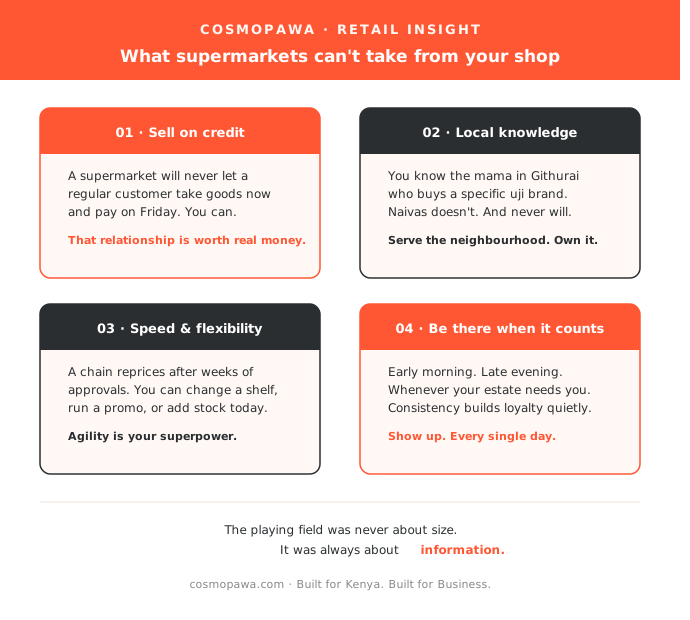
  • Sell on credit — a supermarket will never let a regular customer take goods now and pay on Friday. Your loyal customer can. That relationship is worth real money.
  • Stock hyper-local preferences — the mama in Githurai who buys a specific brand of uji flour, or the mechanic in Industrial Area who takes Ketepa every morning. You know them. Naivas doesn’t.
  • Move fast — a supermarket chain changes pricing or runs a promotion after weeks of approval chains. You can reprice a shelf, run a promotion, or introduce a new product tomorrow.
  • Be open exactly when it matters — early morning, late evening, or whenever your neighbourhood needs you.

The competitive advantage of a neighbourhood shop has always been intimacy and speed. The challenge is that too many small retailers let those advantages erode often because of operational blind spots that are easy to fix.

See How PawaPOS Helps You Run a Tighter Shop

PawaPOS gives you real-time stock visibility, hourly sales reports, and customer purchase history the same operational intelligence the big chains use, built for a neighbourhood business. Chat with us and see it in action.

The Three Operational Leaks That Hurt Small Retailers Most

When a supermarket opens nearby and your sales dip, the easy diagnosis is competition. But often, the real culprits were already there, costing you money before the big chain ever arrived.

1. Inventory You Can’t See

If your stocktake is a weekly event or a gut feeling, you are almost certainly carrying dead stock on some shelves while running out of fast-movers on others. A supermarket’s systems tell it exactly what to reorder and when. Your advantage is flexibility — but only if you have the same visibility into what’s actually moving.

2. Sales Data That Lives in Your Head

Most independent retailers can name their top three sellers. But can you say which product makes the most margin? Which hour of the day drives 40% of your revenue? Which customer spends the most per month? That kind of data is what turns a shopkeeper into a retailer — and it’s what separates businesses that grow from businesses that just survive.

3. Cash Handling Gaps

Cash is invisible until it isn’t. The KES 200 discrepancy at close of day, the sale that wasn’t rung through, the stock that left the shelf but not the records — these are the leaks that quietly drain a small retail business. The cost of cash handling in Kenya’s informal retail sector runs far higher than most owners realise.

Five Practical Ways to Compete — Starting This Week

Competition from large chains is not new. Naivas itself started as a small family shop in Rongai in 1990. What changed for them was systems, capital, and scale. You don’t need their capital. But you do need their discipline about data.

  • Know your top 20 products inside out. Stock them deep, price them right, and never let them run out. A supermarket beats you on range. Beat them on reliability for what your customers need most.
  • Track your customers, not just your stock. Even a basic record of who buys what — through a POS system or a simple register — lets you run personal promotions, extend the right credit limits, and reach out when someone stops coming in.
  • Own your opening hours. Find out when your neighbourhood needs you most and be consistently there. Consistency is a form of loyalty-building that costs nothing.
  • Offer what they can’t. Home delivery to five streets around you. WhatsApp orders. Layaway for the mama who pays weekly. These are services a 100-branch chain cannot operationalise for your specific estate.
  • Run your numbers daily. Even five minutes at close of day comparing what you sold to what you expected teaches you faster than any market research report.

The Role of Technology in Levelling the Playing Field

One of the biggest myths in Kenyan retail is that enterprise-grade business tools are only for large chains. That was true a decade ago. It is not true today.

Cloud-based POS systems like PawaPOS are built specifically for SME retailers — the mini-mart in Umoja, the convenience store in Kitengela, the growing supermarket in Thika town. They bring the same capabilities a chain like Naivas uses to manage 113 branches — live stock tracking, sales reporting, staff accountability, M-Pesa and card payment integration — down to a size and price that works for a single-branch or two-branch business.

The playing field was never about size. It was always about information. A retailer who knows their numbers — even a small one — can consistently outperform a larger competitor who doesn’t. See how poor stock visibility costs retailers money — and what to do about it.

Final Thoughts

Naivas and Quickmart moving into neighbourhood centres is not the end of the independent Kenyan retailer. It is a reminder that the market is maturing — and that the operators who survive will be the ones who run tight businesses, know their customers, and use every advantage they have.

You know your neighbourhood. You know your customers. You have the speed and flexibility no chain can match. The only question is whether your operations are sharp enough to make the most of those advantages.

If you want to see how PawaPOS can help you tighten your operations, talk to us today.

Is your shop running as tightly as it could?

PawaPOS gives you real-time stock visibility, sales reports by the hour, and customer purchase history — the same tools the big chains use, built for a neighbourhood business.

Chat With Us on WhatsApp →

Inventory Shrinkage How to Detect Theft or Losses with Your POS

Why Your Stock Keeps Disappearing (And How to Stop It)

Every Kenyan retailer loses stock they never sold. The question isn’t if shrinkage is happening in your shop — it’s how much, and whether your POS system is built to catch it before it silently kills your margins.


In This Article

  1. What Is Inventory Shrinkage?
  2. The 5 Biggest Causes (and the Kenyan Reality)
  3. The True Cost Kenyan SMEs Rarely Calculate
  4. How Your POS System Detects Shrinkage
  5. 6 Prevention Best Practices for Kenyan Retailers
  6. Red Flags to Check in Your Reports Right Now
  7. Frequently Asked Questions

What Is Inventory Shrinkage — and Why Should Every Kenyan Retailer Care?

Inventory shrinkage is the gap between what your records say you own and what you actually have on your shelves. You ordered 50 units of Royco, your POS says 12 remain — but a physical count finds only 7. Those missing 5 units are shrinkage. You’ll never sell them, but you already paid for them.

For the average Kenyan SME retailer, shrinkage is a silent drain on cash flow. It inflates your apparent cost of goods, distorts your reorder calculations, and — left unchecked — can wipe out the thin margins that keep a shop profitable in a high-competition market like Nairobi’s.

Shrinkage CategoryGlobal Share
Employee / Internal Theft~35%
Shoplifting & External Theft~38%
Administrative & Process Errors~21%
Vendor / Supplier Fraud~6%
Global retail shrinkage benchmarks. Kenyan SMEs without POS oversight typically experience rates above the 1.5% global average.

These are global benchmarks. In the Kenyan context — where many SMEs still rely on manual stock counts, shared till access, and informal supplier relationships — the true shrinkage rate is often higher. The good news: a well-configured POS system addresses almost every category.


The 5 Biggest Causes of Inventory Shrinkage (and the Kenyan Reality)

Understanding where your stock goes is the first step toward stopping it. Each cause calls for a different response — and your POS system plays a different role in each.

1. Shoplifting & External Theft

Customers walking out with unpaid goods. In busy Nairobi supermarkets and dukas, small high-value items — batteries, razors, medicine sachets — are prime targets. Your POS can’t stop a determined shoplifter, but it flags items with persistent stock-versus-sales discrepancies so you know which SKUs need more physical security attention.

2. Employee Theft (The Biggest Blind Spot)

Internal theft is consistently the most damaging shrinkage category for SMEs — and the hardest to confront. It takes many forms: a cashier who doesn’t ring up a friend’s purchase, a stockroom attendant pocketing goods, or a manager voiding legitimate transactions and pocketing the cash. A POS with per-employee audit trails and void-approval workflows makes these patterns visible and deterrable.

3. Administrative & Process Errors

Not all shrinkage is theft. A supplier delivers 48 bags of flour but your system receipts 50. A cashier rings up the wrong SKU. A stocktake is done while a delivery is mid-shelf. These honest mistakes compound quietly over months. Your POS catches them through goods-received reconciliation and automatic recount prompts.

4. Vendor & Supplier Fraud

Short-shipping — where a supplier delivers fewer units than invoiced — is more common than Kenyan retailers like to admit. Some delivery staff are organised about it. A POS system that enforces a goods received note (GRN) workflow before updating inventory creates an automatic paper trail that protects you during supplier disputes.

5. Damage, Spoilage & Obsolescence

Perishables that expire, goods damaged in transit, products that lose viability before sale. These are legitimate losses, but they must be captured and recorded in your POS — not left as unexplained discrepancies. Proper write-off categories keep your records honest and your tax documentation clean for KRA compliance.


The True Cost Kenyan SMEs Rarely Calculate

Say your shop turns over KES 500,000 per month. A shrinkage rate of just 2% — modest by global standards — means KES 10,000 in losses every single month. That’s KES 120,000 per year. Enough to pay a staff member’s annual salary. Enough to fund an entire stock replenishment cycle.

Shrinkage doesn’t appear as a line item on your P&L. It hides inside your cost of goods — which is exactly why most retailers only notice it when margins suddenly collapse.

Beyond the direct monetary loss, shrinkage distorts every downstream business decision: you reorder stock you think you’re running low on (but has been stolen), you misread supplier performance, and you build inaccurate sales data into your growth planning.

A common Kenyan retailer trap: Many shop owners attribute declining margins to rising supplier prices or reduced foot traffic — without ever checking whether shrinkage has quietly doubled. If your margins are thinning but your sales volume is flat, run a full stocktake this week. The numbers will tell you a story.


How Your POS System Detects Inventory Shrinkage

A modern cloud-based POS system — like PawaPOS by CosmoPawa — is the single most effective tool for shrinkage detection available to a Kenyan SME. Here’s exactly how each feature maps to a real detection capability:

01 — Real-Time Inventory Tracking

Every sale, return, and manual adjustment moves the stock count instantly. A sudden, unexplained drop in a specific SKU — outside of normal sales activity — triggers an immediate review prompt. No more discovering a theft problem at month-end when the trail has gone cold.

02 — Transaction Audit Trails & Void Monitoring

Every action in a POS is logged against the user who performed it. Voids, discounts, and price overrides are especially powerful signals — an employee with a disproportionately high void rate compared to colleagues warrants a closer look. PawaPOS logs and time-stamps every transaction action, creating a clear accountability record.

03 — Employee-Level Sales & Performance Reports

When you can see each cashier’s totals, voids, discount usage, and items-per-transaction rate in one report, outliers surface naturally. Honest cashiers produce consistent patterns. Problematic behaviour creates statistical noise — and a good POS makes that noise visible to management.

04 — User Permissions & Access Controls

Segregating what each employee can do inside the POS is shrinkage prevention built in. Cashiers shouldn’t be able to process their own returns. Stock adjustments shouldn’t be possible without manager approval. Role-based permissions enforce the internal controls that prevent most opportunistic theft before it starts.

05 — Negative Stock & Discrepancy Alerts

If your POS shows you selling items that aren’t physically in stock (negative inventory), something is broken in your receiving or counting process. Automatic alerts on negative stock or stock below a defined threshold catch data-entry errors and unrecorded receipts before they compound into large unexplained losses.

06 — Goods Received Note (GRN) Reconciliation

When supplier deliveries are entered into the POS before stock is placed on shelves, you create a tamper-evident paper trail. Discrepancies between the delivery note, the GRN, and the eventual stock count point directly to where a loss occurred in the supply chain — protecting you during vendor disputes and supplier audits.


6 Inventory Shrinkage Prevention Best Practices for Kenyan Retailers

Detection tells you what happened. Prevention stops it from happening again. These six practices, paired with a capable POS system, significantly reduce shrinkage risk for any Kenyan retail business:

  1. Conduct regular, surprise stocktakes. Don’t just do stocktakes at month-end. Unannounced partial counts on specific product categories — especially high-value or fast-moving items — make it much harder to pre-empt and hide theft. Your POS provides the starting count; you verify with a physical tally.
  2. Use blind counts for accountability. When running a stocktake, don’t show employees the system’s expected count before they count physically. Blind counting removes the temptation to adjust physical counts to match records rather than reality.
  3. Require manager approval for all voids and large discounts. This single policy change — enforced through your POS permission system — eliminates the most common form of cashier-level fraud. No void goes unreviewed.
  4. Train your team on loss prevention and make it visible. Staff who know the POS tracks every action, and who understand why that matters for the business, are significantly less likely to act dishonestly. Make loss prevention part of onboarding and regular team reviews.
  5. Use a two-person check for all supplier deliveries. Never let one employee receive and sign off on a delivery alone. Two-person receiving, documented in the POS GRN workflow, creates accountability at the most vulnerable point in your supply chain.
  6. Set reorder alerts above your actual minimum. Low-stock triggers are not just for purchasing — stock that drops below a threshold faster than sales justify is an early shrinkage indicator. Let your POS surface these anomalies before they become expensive patterns.

Red Flags to Check in Your POS Reports Right Now

Open your POS reports today and look for any of the following. Any single one of these warrants immediate investigation:

  • A cashier whose void rate is more than 2× the team average.
  • Stock levels for specific SKUs that drop between closing and opening — before the shop opens.
  • Items regularly showing negative inventory not explained by an unprocessed delivery.
  • A consistently high number of “no sale” drawer opens by one employee.
  • Products with strong sales records but significantly lower physical stock than the POS reports.
  • Returns processed without a corresponding original sale in the system.
  • Discount rates significantly above average for a specific employee or shift.

None of these individually constitute proof of theft — some have innocent explanations. But each is a signal worth investigating. Your POS data exists precisely to surface these patterns. Use it.


Frequently Asked Questions

What is the average inventory shrinkage rate for retail in Kenya?

Kenya-specific retail shrinkage data is limited, but Kenyan retailers generally experience rates between 1% and 3% of revenue. For SMEs with manual processes or shared till access, rates are often higher. Global benchmarks put the average at around 1.5% — but SMEs without POS systems consistently outperform that figure in losses.

How does a cloud POS system help Kenyan businesses track inventory better?

A cloud POS like PawaPOS updates inventory in real time across all users and devices. You can check stock levels remotely, receive instant alerts for anomalies, and run historical reports to spot patterns — all without being physically present in the shop. For multi-branch retailers, this cross-location visibility is especially powerful for catching branch-level shrinkage.

How often should a Kenyan retailer do a stocktake?

For most Kenyan SMEs, a full stocktake monthly is the minimum. High-value or fast-moving categories — electronics accessories, alcohol, personal care — benefit from weekly spot-checks. The goal is not to count constantly; it’s to count unpredictably enough that the timing can’t be anticipated by anyone trying to manipulate the results.

Can a POS system definitively catch employee theft?

A POS system surfaces patterns and anomalies that indicate potential theft — it doesn’t produce a confession on its own. However, the combination of transaction audit trails, employee-level reports, and physical stocktake discrepancies builds a very strong evidentiary picture. More importantly, the knowledge that every action is logged significantly deters opportunistic theft in the first place.

What’s the difference between shrinkage and wastage for a food retailer?

Wastage — spoilage, damage, expiry — is a legitimate cost of doing business for perishable retailers. Shrinkage refers specifically to unexplained losses: goods that should be in stock but aren’t, without a documented reason. For food retailers, it’s critical to properly record and categorise wastage in your POS so that genuine write-offs aren’t confused with theft, and vice versa.

Ready to protect your inventory?

Stop the Silent Stock Drain

PawaPOS gives Kenyan retailers real-time inventory visibility, full audit trails, and employee controls to detect and stop shrinkage from day one. Talk to us — we’re based right here in Nairobi.

Visit us Cosmo House, Mawe Mbili Rd
near Ruai Bypass, Nairobi

No commitment required  ·  Kenyan-built for Kenyan businesses  ·  cosmopawa.com